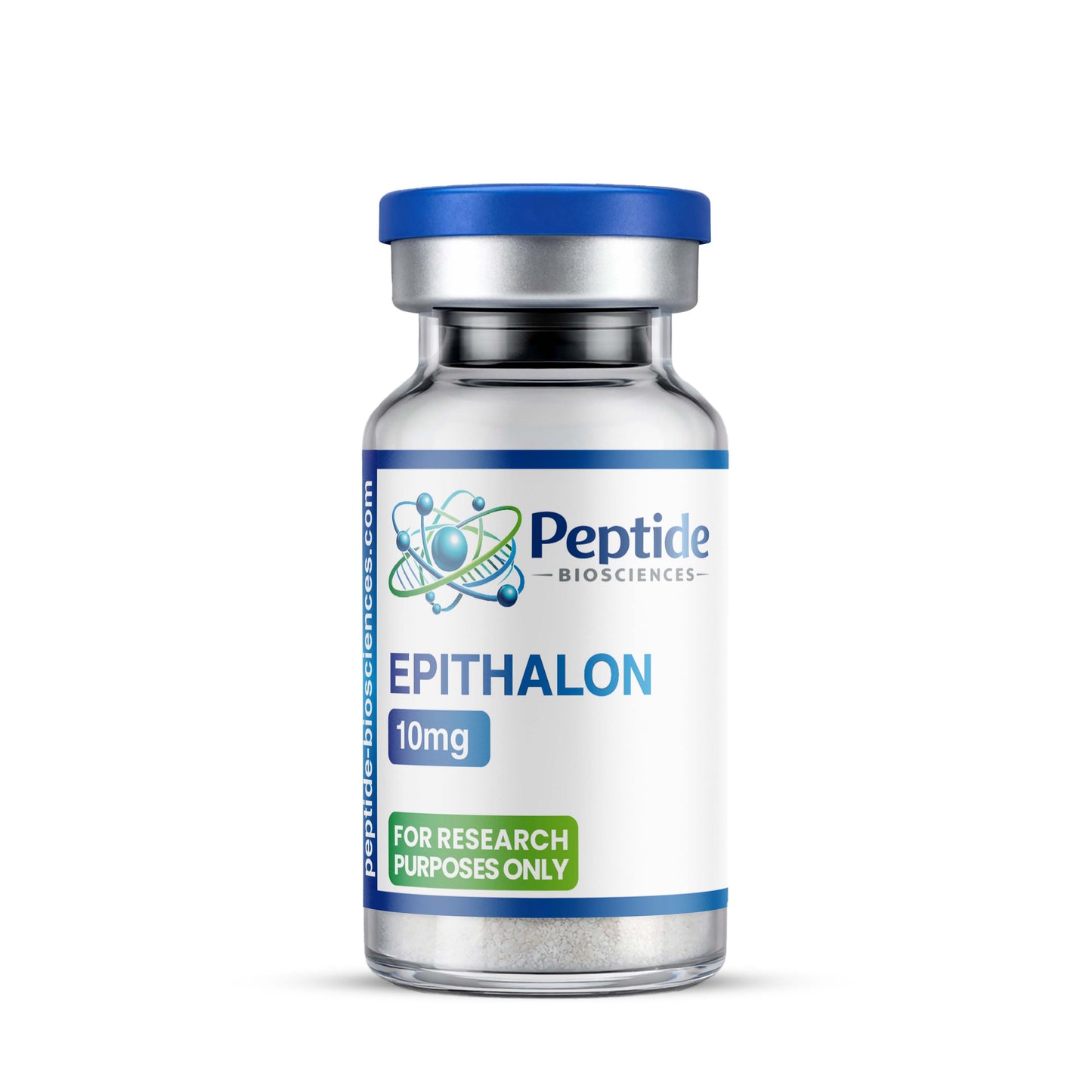


Epithalon (Epitalon)
Epithalon (Epitalon)
Multi-buy savings: save 4% on 2+ items and 6% on 3+. Applied automatically in your cart.
Couldn't load pickup availability
- Same-day dispatch on orders before 2pm, Royal Mail Tracked
- Free UK shipping on orders over £100
- Certificate of Analysis with every order · Request CoA
- For in vitro laboratory research use only
Concentration calculator
For laboratory calculation only. Not for human or veterinary use.
Epithalon (Epitalon) (Ala-Glu-Asp-Gly) is a synthetic tetrapeptide analogue of Epithalamin, a polypeptide extract of the pineal gland. Developed by Vladimir Khavinson and colleagues at the Saint Petersburg Institute of Bioregulation and Gerontology, Epithalon is studied for its role in telomerase activation, telomere elongation, and cellular aging regulation.
Foundational research has demonstrated that Epithalon can induce expression of the catalytic subunit of telomerase (hTERT) in human somatic cells that normally lack this activity, resulting in measurable telomere elongation and extended cell division capacity beyond the Hayflick limit. Animal studies have reported significant life span extension in rodent models. This makes it one of the most studied synthetic tetrapeptides in longevity and cellular aging research.
Specifications
| CAS | 307297-39-8 |
|---|---|
| Formula | C14H22N4O9 |
| MW | 390.3 g/mol |
| Purity | ≥99% HPLC |
| Format | Lyophilised powder |
| Storage | −20 °C |
Research areas
- Telomerase activation
- Telomere elongation
- Cellular senescence
- Pineal gland biology
- Longevity research
- Hayflick limit models
Selected literature
Research Use Only. Supplied strictly for in vitro laboratory research by qualified professionals. Not for human or veterinary administration. Not evaluated by the MHRA or FDA for therapeutic use. Researchers must comply with the Human Medicines Regulations 2012 and all applicable institutional guidelines. Peptide Biosciences accepts no liability for use outside a controlled research context.
Share