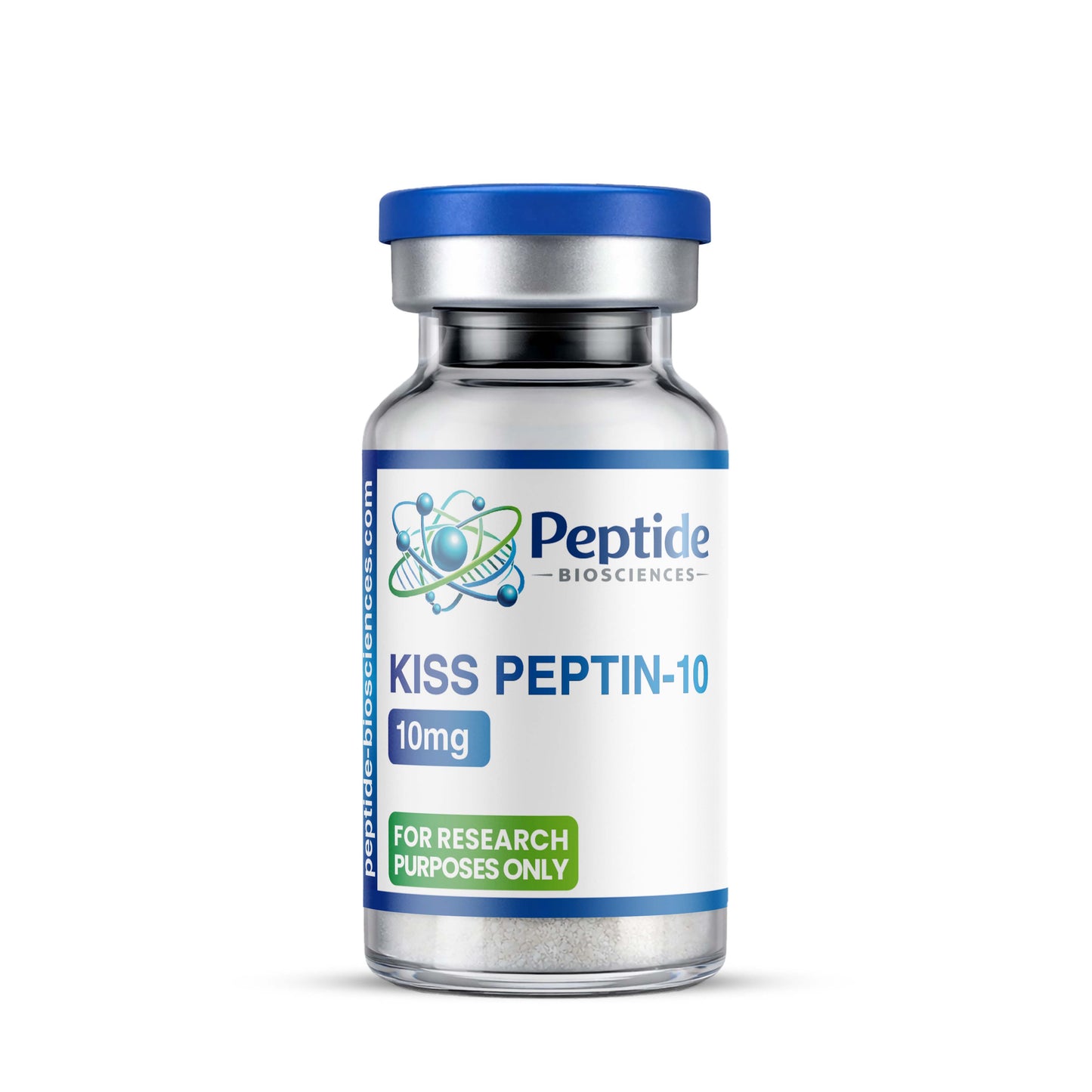


Kisspeptin-10
Kisspeptin-10
Multi-buy savings: save 4% on 2+ items and 6% on 3+. Applied automatically in your cart.
Couldn't load pickup availability
- Same-day dispatch on orders before 2pm, Royal Mail Tracked
- Free UK shipping on orders over £100
- Certificate of Analysis with every order · Request CoA
- For in vitro laboratory research use only
Concentration calculator
For laboratory calculation only. Not for human or veterinary use.
Kisspeptin-10 (Tyr-Asn-Trp-Asn-Ser-Phe-Gly-Leu-Arg-Phe-NH₂) is the C-terminal decapeptide fragment of the kisspeptin family of neuropeptides, encoded by the KISS1 gene. It is the minimum active sequence required for full activation of GPR54 (KISS1R), the G-protein coupled receptor that serves as the principal regulator of gonadotropin-releasing hormone (GnRH) neuron activity.
Research has established kisspeptin-10 as a pivotal gatekeeper of the hypothalamic-pituitary-gonadal (HPG) axis, making it central to investigations of puberty onset, reproductive endocrinology, and fertility regulation. It is widely used in vitro and in vivo to probe GPR54 signalling, GnRH pulse generation, LH and FSH secretion, and the neuroendocrine control of reproduction. Kisspeptin-10 is also studied in the context of cancer biology due to KISS1's role as a metastasis suppressor.
Specifications
| CAS | 374671-08-6 |
|---|---|
| Formula | C63H83N15O13S |
| MW | 1302.5 g/mol |
| Purity | ≥99% HPLC |
| Format | Lyophilised powder |
| Storage | −20 °C |
Research areas
- GPR54 / KISS1R pharmacology
- GnRH regulation
- HPG axis biology
- Reproductive endocrinology
- Puberty research
- Metastasis suppression models
Selected literature
Research Use Only. Supplied strictly for in vitro laboratory research by qualified professionals. Not for human or veterinary administration. Not evaluated by the MHRA or FDA for therapeutic use. Researchers must comply with the Human Medicines Regulations 2012 and all applicable institutional guidelines. Peptide Biosciences accepts no liability for use outside a controlled research context.
Share